

Writing Through November: Keeping Momentum When the Nights Draw In
Short daily sessions, warm lamps and small rituals can keep a draft moving through November's dark evenings. A practical guide to writing twenty minutes at a time.
By four o'clock the light has gone, the radiators are ticking, and the paragraph you were certain about on Tuesday has quietly stopped making sense. November does that. It doesn't stop you writing so much as slow everything down, until the notebook stays shut and you start telling yourself you'll begin properly in January.
You won't need a better plan in January. You need a smaller one now — something that fits into a dark evening, doesn't depend on inspiration, and survives the week before Christmas.
Twenty Minutes Is a Real Session
The mistake most writers make in winter is scale. A two-hour evening session sounds serious, so it becomes the standard, so anything less feels like failure, so nothing happens at all. Twenty focused minutes, five days a week, is not a compromise. It's roughly a hundred minutes of new prose a week: enough to build a short story, a chapter, or the bones of something longer before the year turns.
The trick is to stop measuring sessions by how they felt and start measuring them by whether they happened. A scrappy, badly punctuated page written at half past nine on a wet Wednesday counts. It counts more than the brilliant scene you composed in your head while washing up.
Warmth Is Part of the Method
Cold hands make slow writing. If your fingers are stiff and your shoulders are up around your ears, no amount of discipline will get you into a flow. Deal with the body first, then the sentence.
- Heat the room before you sit down, not while you're in it. Ten minutes early makes a noticeable difference.
- Keep a jumper, blanket or hot water bottle within reach so you don't have to leave the desk mid-paragraph.
- Make a drink you actually like and put it beside you. It will go cold. That's part of the rhythm.
- Sit with a wall behind you if the room is draughty, rather than facing a window that leaks cold air.
Rituals matter more in winter than in summer, because the season gives you fewer cues. Same chair, same mug, same three songs before you start. The point isn't superstition. It's that a familiar set of conditions tells your brain what comes next, so you spend less of your twenty minutes deciding to begin.
Lighting the Desk for a Dark Evening
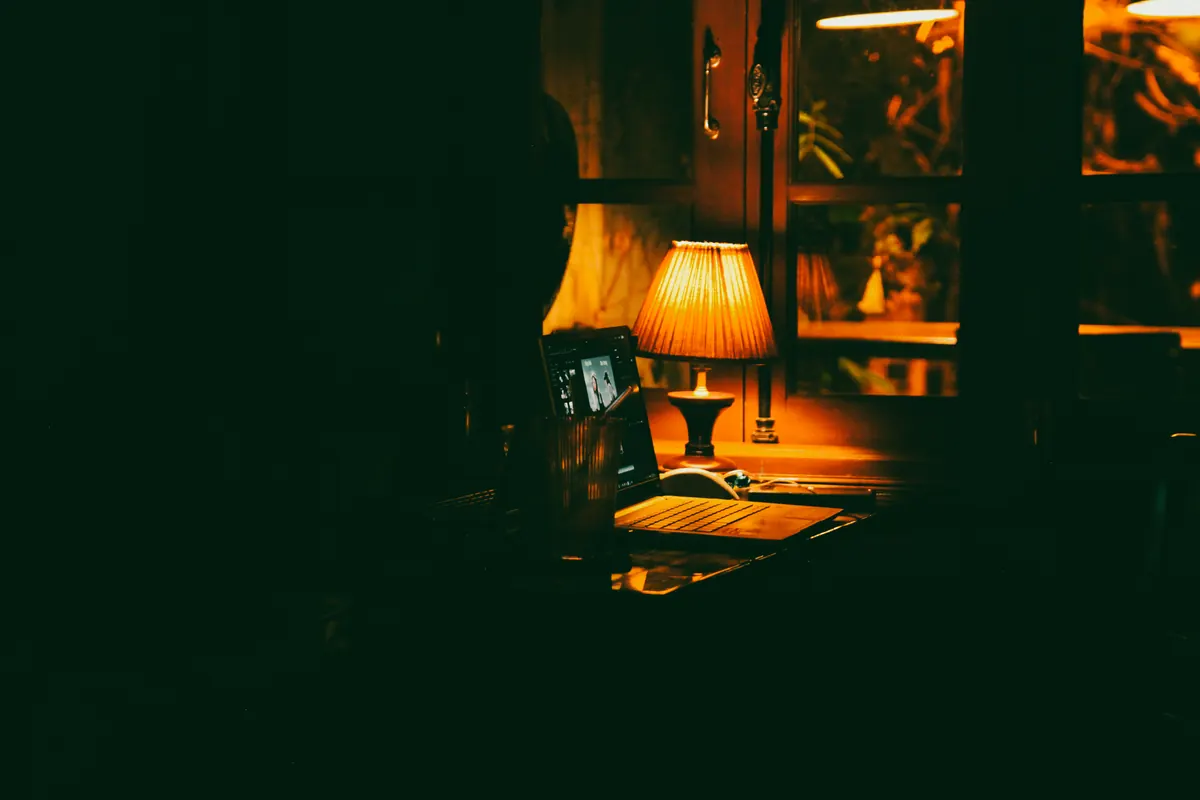
The single most useful change is a small warm lamp at desk level instead of the ceiling light. Overhead lighting flattens the room and throws glare across the screen; a low pool of light tells you where the work is.
- Choose a warm-white bulb for the working lamp. Cool, blue-white light at night feels clinical and tiring.
- Place the lamp to the side of your screen, not behind it and not in front of you, so nothing reflects in the glass.
- Turn screen brightness down as the room darkens. A bright screen in a black room is the quickest route to a headache.
- Give your eyes somewhere else to rest every few minutes — the far corner of the room, a picture, the window — rather than holding one distance.
- If screens leave you gritty-eyed by nine, draft the old way. A notebook and pen work perfectly well by lamplight.
If low mood, poor sleep or heavy fatigue settles in and stays through the winter, treat it as something to raise with your GP rather than a discipline problem to solve with a word count.
A Twenty-Minute Session, Step by Step
- Decide the one thing before you sit down. Not "work on the novel" but "write the scene where she misses the train".
- Set a timer for twenty minutes and put the phone in another room, or at least face down and silent.
- Read the last paragraph you wrote, then start writing. Do not start editing.
- Write forward, not sideways. If you need a fact, a name or a better word, leave a bracket and keep going.
- Stop when the timer goes, even if it's going well.
- Before you close the notebook, write one line telling tomorrow's self where to start.
Steps five and six look counterproductive. They're what makes the next session easy. Leaving a sentence half-finished hands you a running start when you return.
What to Write When the Light Goes
Winter writing doesn't have to be gloomy, but it can be specific. The season hands you material you don't have to invent: the smell of wet coats on a bus, the knock of a radiator, the particular grey of a four o'clock sky, the way a car park looks under floodlights. Carry a small notebook for a fortnight and you'll collect more usable detail than a month of free-writing.
If you're stuck mid-draft, drop the project for one session and write a page in your character's voice describing their journey home in the dark. That isn't procrastination; it's research you can steal from later. Or spend the twenty minutes reading a book you admire and copying out one paragraph by hand. It warms the ear, and it counts as work.
When You Miss a Day (or a Week)
Missing days is normal in November. What matters is the response. Don't schedule a three-hour catch-up to atone for the gap; that turns writing into a debt you can never clear. Come back with ten minutes and no expectations. Lower the bar until you can step over it.
Two things help. First, fix the time rather than the amount: "after supper, before the washing up" is easier to keep than "an hour at some point". Second, mark each session on a calendar with a tick or a dot, so you're looking at the pattern rather than the gaps. And if mornings suit you better, take the early slot seriously. Half past six in a lit kitchen beats nine at night, when the day has already won.
Your Plan for the Rest of the Year
Keep it to four things: choose a time; set up a warm lamp; write for twenty minutes at that time for five days; leave a note each night telling tomorrow where to start. Nothing in that plan depends on feeling inspired, and nothing in it collapses when the evenings shorten — which they will, for a few weeks yet.
The draft you finish in the dark is the same draft you'd have finished in June. It simply arrives with more tea stains on it.
Photo: Minh Hải Nguyễn / Pexels